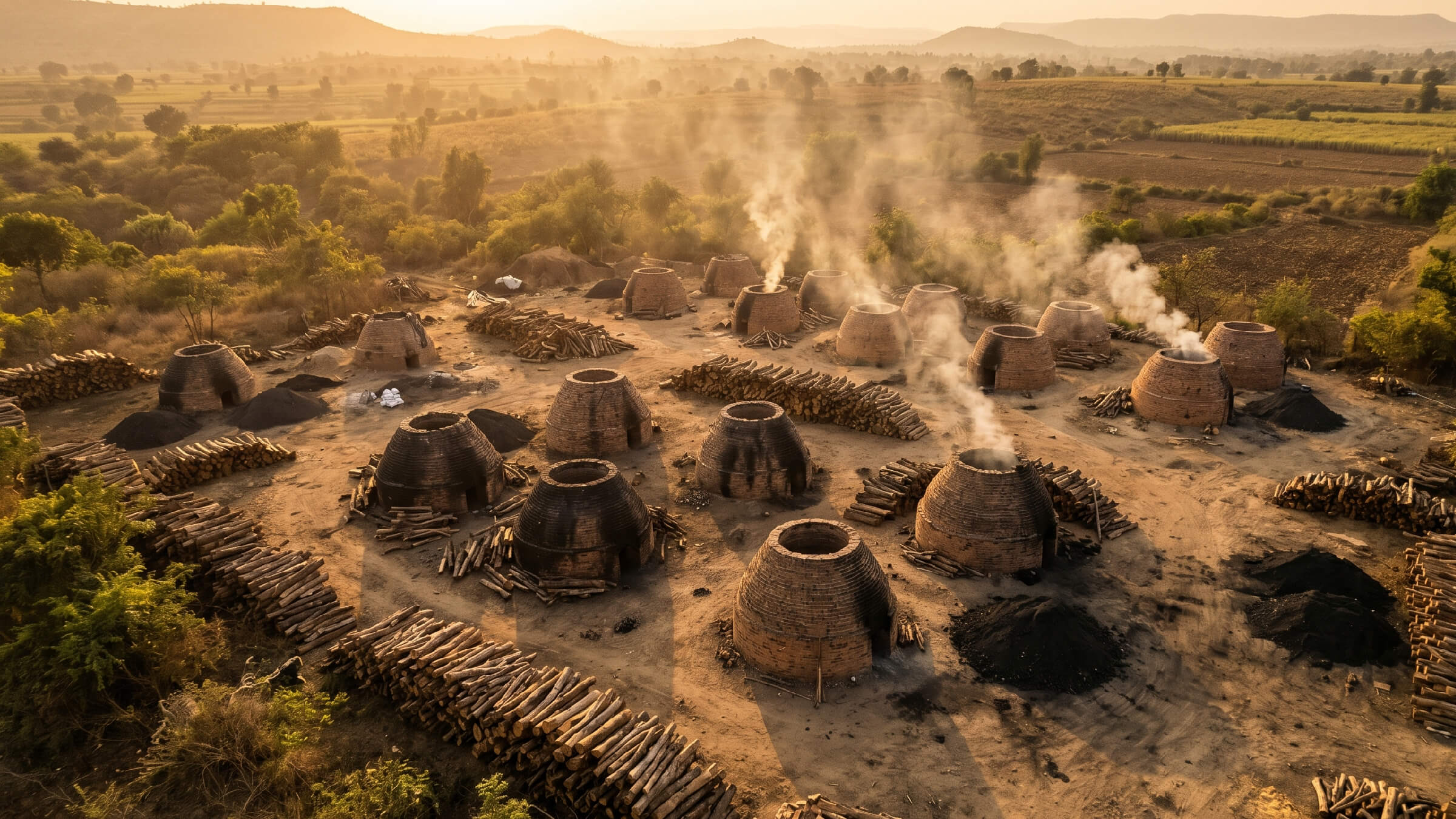
Foundries, smelters & blacksmiths
Industrial charcoal at >75% fixed carbon, with the COA to prove it.
Ferro-alloy smelters, silicon reduction, foundry carbon supplementation, blacksmith forges and metallurgy training schools. High-carbon, low-ash, low-sulphur charcoal as a renewable alternative to metallurgical coke — graded, packed, and shipped direct to your dock with per-lot COA on request.
Why charcoal for industrial heat
>75% fixed carbon
with <3% ash and <5% moisture — meets the reduction-grade spec ferro-alloy and silicon smelters typically qualify against.
Low sulphur (<0.05%)
versus 0.6-1.2% for typical met-coke, meaning less SO₂ in the off-gas and reduced downstream desulphurisation load.
Renewable carbon
kiln-produced from plantation hardwood, not fossil-derived. Important for buyers tracking Scope 3 emissions or chasing renewable-input certification.
Size grading
standard 20-80mm with fines screened out (<5%). Custom gradings on 5 MT+ orders (10-30mm for reduction reactors, 50-100mm for forges).
Lot-level documentation
per-lot COA on request covering fixed C, ash, moisture, VM, calorific value. SGS / Bureau Veritas third-party verification at additional cost.
Spec values cited above are indicative; final values come from the per-lot COA shipped with each order.
The industrial SKU mix
Industrial lumps are the reduction-grade workhorse. Fines feed binder-bound briquetting. Briquettes give predictable size for hopper-fed lines. Softwood lump is the blacksmith / forge favourite for fast, hot, light-flavour fires.
- 01 Industrial Charcoal Lumps
>75% fixed carbon, <3% ash — for ferro-alloy reduction, silicon smelting, foundry coke replacement
Fixed C: > 75% Ash: < 3% CV: 7,400 kcal/kg From ₹149 - 02 Charcoal Fines
Sub-mm fines for binder feedstock, briquetting input, and soil-carbon programmes
Fixed C: 65–72% Ash: < 10% From ₹99 - 03 Wood Charcoal Briquettes
Compressed hardwood briquettes for industrial heat applications needing predictable size and burn
Fixed C: 68–72% Ash: 6–8% CV: 6,800 kcal/kg From ₹149 - 04 Softwood Charcoal Lumps
Pine / cedar / fir — favoured by blacksmiths and forges for fast, hot, light-flavour fires
Fixed C: 65–72% Ash: 4–6% CV: 6,800 kcal/kg From ₹129
Industrial-volume savings
1 MT / month at tier 3 (15% off) typically saves ₹15,000–₹30,000 / month vs. retail.
Truckload accounts running 5-22 MT settle on a quoted FOB-dock price with dedicated freight, sized to your spec sheet.
Why charcoal beats the alternatives
Charcoal vs. metallurgical coke
Charcoal carries far lower sulphur (<0.05% vs. 0.6-1.2% for met-coke), letting smelters cut SO₂ emissions and reduce desulphurisation load. Trade-off is bulk density — most buyers blend at 15-40% replacement to balance both economics and emissions.
Charcoal vs. natural gas reduction
Charcoal IS the carbon source — gas only provides heat. For ferro-alloy and silicon reduction the process needs solid carbon to reduce the metal oxide. Charcoal also gives renewable-carbon traceability that fossil gas can't.
Industrial buyers — FAQ
What fixed-carbon percentage do I need for forging or smelting?
It depends on the application. Blacksmith forges typically run fine on 65-75% fixed-carbon material (our softwood lumps suit traditional bellows-fed forges well; hardwood lump for heavier work). Ferro-alloy reduction and silicon smelting want >75% fixed carbon with <3% ash and tight moisture control — that's our Industrial Charcoal Lumps spec. Pharma-grade or speciality metallurgy applications may need >85% — talk to sales about a custom spec.
What are the minimum order quantities for industrial supply?
Industrial-grade lumps have a 500 kg practical MOQ and ship most economically at 1 MT and above. Standard supply is 50 kg woven sacks on a pallet (typical 20 sacks / 1 MT pallet) or 1 MT jumbo bags for direct hopper feed. Truckload supply (5-22 MT) ships dedicated freight direct to your loading dock — typical lead time is 7-14 days from PO depending on lot availability.
Are spec certificates and lot-level COAs available?
Yes. Per-lot Certificate of Analysis is available on request covering fixed carbon, ash, moisture, volatile matter and calorific value. Third-party SGS or Bureau Veritas verification can be added at additional cost — typical for export orders and for first-time qualification with a new ferro-alloy or silicon smelter. MSDS ships with every order.
How does charcoal compare with metallurgical coke for our process?
Charcoal is a renewable, low-sulphur alternative to met-coke with two practical wins for the carbon-conscious metallurgical buyer: (1) sulphur typically <0.05% vs. 0.6-1.2% for met-coke, meaning lower SO₂ emissions and less downstream desulphurisation; (2) higher reactivity than coke for fast-temperature applications. The trade-off is bulk density — charcoal is less dense, so feed volumes are higher per tonne of metal. Most users we supply blend charcoal + coke at 15-40% replacement to balance both vectors.
Do you supply blacksmiths and forging schools as well as large smelters?
Yes — we supply working blacksmiths, traditional iron-forge artisans and metallurgy training schools alongside industrial smelter accounts. Smaller users typically order 50-200 kg / month in standard packs (industrial lump 50 kg sacks, softwood lump for traditional forges). The same lot-COA-on-request applies; the difference is freight format (Shiprocket courier vs. dedicated truck).
Can you supply a specific particle size or grading?
Yes. Standard industrial grade is 20-80mm graded with fines screened out (<5%). Custom gradings are available on 5 MT+ orders — typical custom specs are 10-30mm for hopper-fed reduction reactors, or 50-100mm for slow-feed forge applications. The Charcoal Fines product (sub-mm) is also stocked separately as input for binder-bound briquetting.