Every claim, every number, every certificate.
This page is the audit trail for everything we say elsewhere on the site. If a number appears in a PDP or a category headline, it traces back here, and from here to a verifiable source or an available certificate.
Feedstock provenance
Three raw materials. Three different sustainability stories.
"Charcoal" is not a monolith. The carbon footprint of a kilogram of charcoal depends on what burnt to make it. We work with three feedstocks and the rationale is different for each.
Plantation pruning, not deforestation
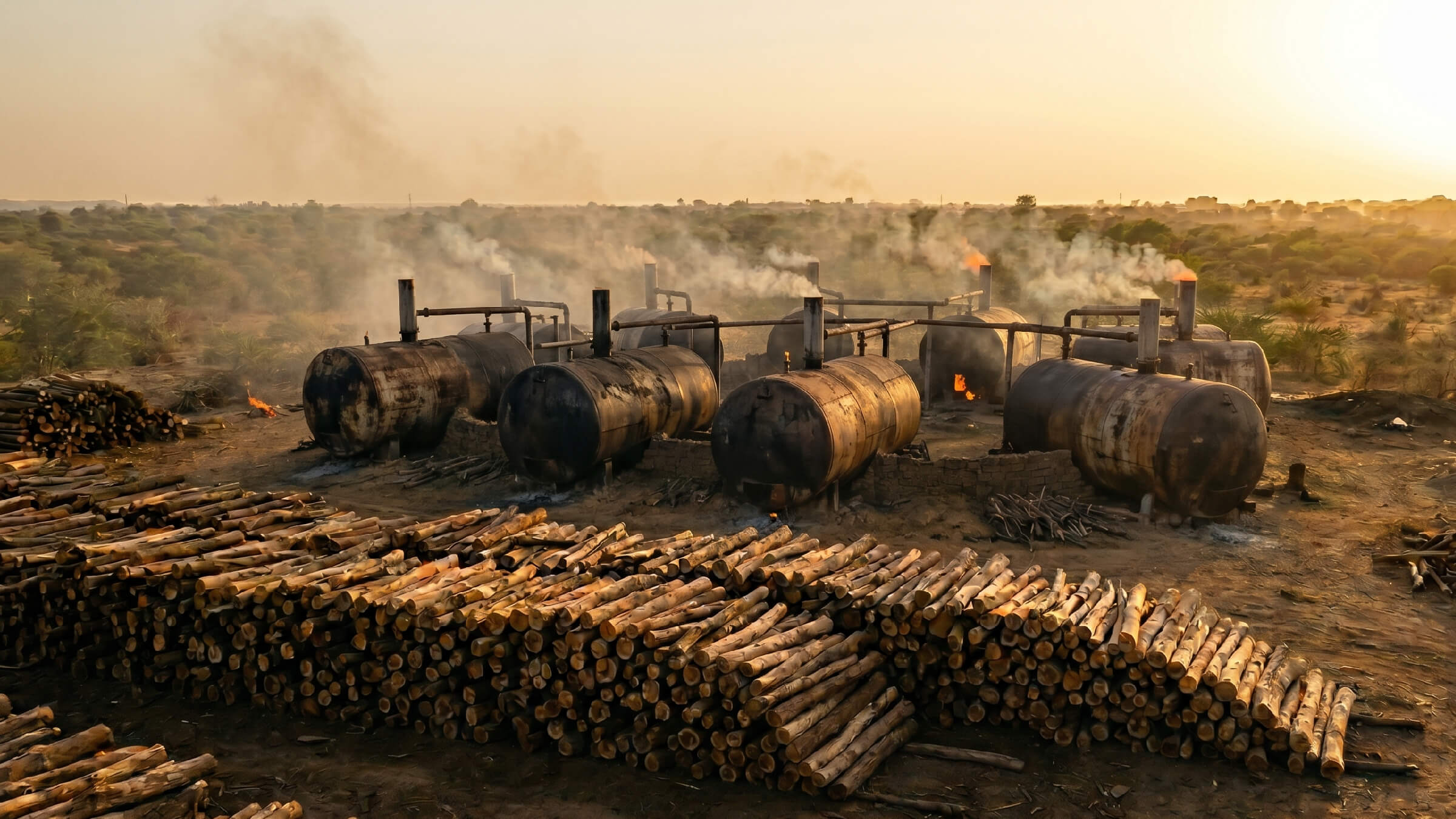
Our wood charcoal is carbonised from acacia, casuarina and mango orchard prunings — the branches and offcuts a plantation owner would otherwise burn at the site. We also take sawmill offcuts from licensed timber operations. No primary or old-growth forest is felled for our product. State Forest Department transit permits are on file for every consignment.
3–5 year regrowth vs 20–50 for hardwood
Bambusa balcooa and Moso bamboo regenerate from rhizome and reach harvestable maturity in 3–5 years. The mother plant is not killed by harvest — culms are cut and the grove keeps growing. Per-hectare carbon sequestration over a 30-year cycle is consistently higher than hardwood plantation forestry in peer-reviewed Indian LCA studies.
100% waste-stream valorization
The shells we carbonise are a byproduct of the Tamil Nadu and Kerala copra and coconut-oil industry. Before procurement contracts existed, those shells were field-burned (causing air-quality issues) or landfilled. Carbonising them retains the carbon as a stable, usable form — including activated carbon for water filtration, which has its own downstream impact story.
The honest comparison
Charcoal vs LPG, propane and synthetic briquettes.
Six axes that actually matter to a buyer — not the marketing ones. LPG wins on indoor air quality (we'd never argue otherwise). Synthetic briquettes are cheap but carry binder fumes that disqualify them for FSSAI food-contact use. Natural charcoal wins on lifecycle carbon, taste, cost stability and domestic supply.
| Axis | Wood charcoal | Bamboo charcoal | Coconut shell | LPG / propane | Synthetic briquette |
|---|---|---|---|---|---|
| Source material | Plantation pruning + sawmill offcuts | 3–5 year regrowth bamboo (rhizome regeneration) | Coconut-oil industry waste shells | Fossil — petroleum / natural gas fraction | Petroleum coke + coal dust + paraffin binder |
| CO₂ lifecycle | Net low — pruning would have decomposed anyway | Net negative possible (rapid regrowth re-sequesters) | Net low — waste stream displaced from field burning | Fossil emissions, no biogenic offset | Fossil emissions + binder VOCs |
| Cost stability | Stable — domestic plantation supply | Stable — short-cycle domestic crop | Stable — copra industry byproduct | Volatile — pegged to crude oil | Volatile — coke market + import duties |
| Taste / aroma (food) | Authentic smoke character (tandoor, BBQ) | Neutral — clean burn | Neutral — preferred for shisha | Flame only — no smoke aromatics | Off-flavours from binders (not FSSAI for tandoor) |
| Indoor air quality | Outdoor / well-vented kitchens only | Outdoor / well-vented kitchens only | Low-smoke — suitable for shisha lounges with hoods | Best for indoor — minimal particulates | Worst — binder fumes |
| Scale in India | High — plantation forestry surplus | Growing — northeast + Gujarat plantations | High — Tamil Nadu / Kerala copra cluster | High — but import-dependent | Imported — China-dominant supply chain |
Claim inventory
13 claims. 13 substantiations.
Every claim that appears in product copy is listed here with the evidence behind it. Where a third-party certificate isn't yet in hand, we say so — instead of naming a certificate we don't hold. If you see a claim on the site that isn't on this list, mail us at hello@woodcharcoal.in and we'll remove it or add it.
| Claim | Substantiation |
|---|---|
| Wood charcoal made from plantation pruning waste | Sourced from licensed plantation operations (acacia, casuarina, mango orchard prunings) and sawmill offcuts — never primary or old-growth forest. State Forest Department transit permits on file for every consignment. |
| Bamboo charcoal from rapid-regrowth species | Bambusa balcooa and Moso bamboo regrow to harvestable maturity in 3–5 years, versus 20–50 years for typical hardwoods. Carbon sequestration coefficients sourced from peer-reviewed ICFRE bamboo LCA studies. |
| Coconut shell charcoal is 100% waste-stream valorization | Feedstock is shells discarded by copra and coconut-oil processors in Tamil Nadu and Kerala. Before our purchase contracts, the shells were either field-burned (air-quality cost) or landfilled. |
| Fixed carbon ≥ 75% (industrial / BBQ grade) | Per-lot internal lab proximate analysis (ASTM D3172 framework) — value reported on the per-lot COA available on request. |
| Ash content ≤ 4% (premium BBQ / hookah lumps) | Per-lot internal lab analysis. SGS / Bureau Veritas third-party reports issued on request for export and pharma-grade buyers. |
| Moisture ≤ 8% | Verified per lot before packing; below the FSSAI food-contact threshold for tandoor and direct-grill applications. |
| Calorific value ≥ 7,200 Kcal/kg (premium hardwood lump) | Bomb-calorimeter test on a per-lot basis; reported on the per-lot COA. |
| FSSAI compliant (food-contact) | Manufacturing unit holds an active FSSAI registration for charcoal intended for tandoor / direct-grill use. Registration number issued on the GST invoice for B2B buyers. |
| ISO 9001:2015 quality management | Certified for our Rajkot manufacturing operation — quality management system audited annually by an accredited certification body. |
| State Pollution Control Board kiln compliance | Our partner kilns operate under Gujarat / Tamil Nadu / Karnataka SPCB consents to operate. Emission monitoring records available to industrial buyers on request. |
| Halal & Kosher certification available on request | Issued on a per-shipment basis for export buyers (UAE, Saudi Arabia, US, EU). Standard turnaround 2–3 business days against confirmed PO. |
| Plastic-free retail packaging | Kraft paper outer, jute string handle, no shrink-wrap or polybag on retail SKUs ≤ 5 kg. Bulk pallets are PP-strapped (industry-standard — alternatives unsafe for road freight). |
| Sustainable sourcing audit | Independent third-party feedstock provenance audit scheduled for FY 2026–27. Until then, every consignment carries the originating plantation / copra processor's traceability sheet. |
Shipping reality
Charcoal ships by surface only — that's also the lower-emissions option.
Charcoal is classified under UN 1361 (Class 4.2, self-heating substances) for transport. That makes air freight non-viable — every consignment goes by road or sea. The regulatory constraint and the carbon-conscious choice point the same way: sea freight is roughly 1/40th the per-tonne-km emissions of air freight (IMO / IPCC). Pan-India deliveries go by road via Shiprocket; export consignments go FOB Mundra or Nhava Sheva by container ship.
Certifications & compliance
What's audited, what's pending — and the documents you can ask for.
Procurement teams: this is the list your compliance team will ask for. Held certifications are issued against confirmed POs; pending ones we'll name with the target date. No fabricated claims.
- FSSAI registrationFood-contact charcoal (tandoor / direct grill). Registration number printed on every B2B GST invoice.
- ISO 9001:2015Quality management system — Rajkot manufacturing operation. Annual surveillance audit by an accredited body.
- State Pollution Control Board consentKiln operations under Gujarat / Tamil Nadu / Karnataka SPCB consent to operate. Emission records on request.
- Per-lot Certificate of AnalysisFixed carbon, ash, moisture, volatile matter, calorific value. Issued on request against an order reference.
- MSDSMaterial Safety Data Sheet for every product family — UN 1361 hazard classification, storage and handling.
- Halal / Kosher (export)Issued per shipment for UAE, Saudi Arabia, US, EU buyers. 2–3 business day turnaround against confirmed PO.
- Third-party sourcing audit — pendingIndependent feedstock provenance audit scheduled for FY 2026–27. Will publish the report on this page once complete.
- SGS / Bureau Veritas reportIssued on request for export and pharma-grade orders — buyer pays third-party lab fee, we coordinate sampling.
Need an in-name certificate for your GST entity or compliance audit? Email sales@woodcharcoal.in with your GSTIN and the SKU range — turnaround is 1–2 business days.
Impact counter methodology
The math behind every "tonnes valorized" number on the site.
The homepage live counter and per-product impact pills compute from per-SKU coefficients carried in product metadata. The coefficients below are computed transparently from public sources, and we'd rather under-claim than over-claim — air-quality methodology, in particular, has wide IPCC uncertainty bands.
Per kg of charcoal sold
- · ~3.5 kg of orchard pruning / coconut shell waste valorized (carbonisation yield ≈ 28-32%)
- · ~2.4 kg CO₂ avoided vs an LPG-equivalent cooking session (energy-content basis)
- · ~3.1 kg CO₂ avoided vs a synthetic-briquette baseline (petroleum coke + paraffin)
- · ~0.0008 hectares of plantation supported (parallel pruning-sale income per kg dispatched)
- · ~0.8 family-of-4 BBQ sessions powered (1.25 kg average per session, lump grade)
- · UN 1361 surface-only shipping ≈ 1/40th the per-tonne-km emissions of air freight (IMO / IPCC AR6)
Where the numbers come from
- · CO₂ coefficients — MoEFCC India GHG Inventory 2023 + Central Pollution Control Board (CPCB) emission factor database
- · Energy-content factors — Bureau of Energy Efficiency (BEE), Ministry of Power, fuel-equivalence tables
- · Plantation pruning tonnage — State Forest Department transit permit aggregates (Gujarat, Tamil Nadu, Karnataka)
- · Coconut shell waste tonnage — Coconut Development Board (CDB), Ministry of Agriculture & Farmers Welfare, annual report
- · LPG / synthetic briquette lifecycle emissions — Indian Institute of Petroleum Management (IIPM) + IPCC AR6 GWP100 values
- · Bamboo regrowth + carbon sequestration — ICFRE peer-reviewed bamboo LCA studies
Per-SKU coefficients (impact_waste_tonnes_per_unit,
impact_co2_kg_per_unit,
impact_hectares_per_unit,
impact_bbq_sessions_per_unit)
live in product metadata. The live counter sums across every paid
order and is cached server-side for 5 minutes. Source data and
per-lot calculation worksheets are available on request.
Read the story behind the numbers.
This page is the audit trail. The narrative — who we are, who manufactures for us, and our sourcing rules — lives on the About page.