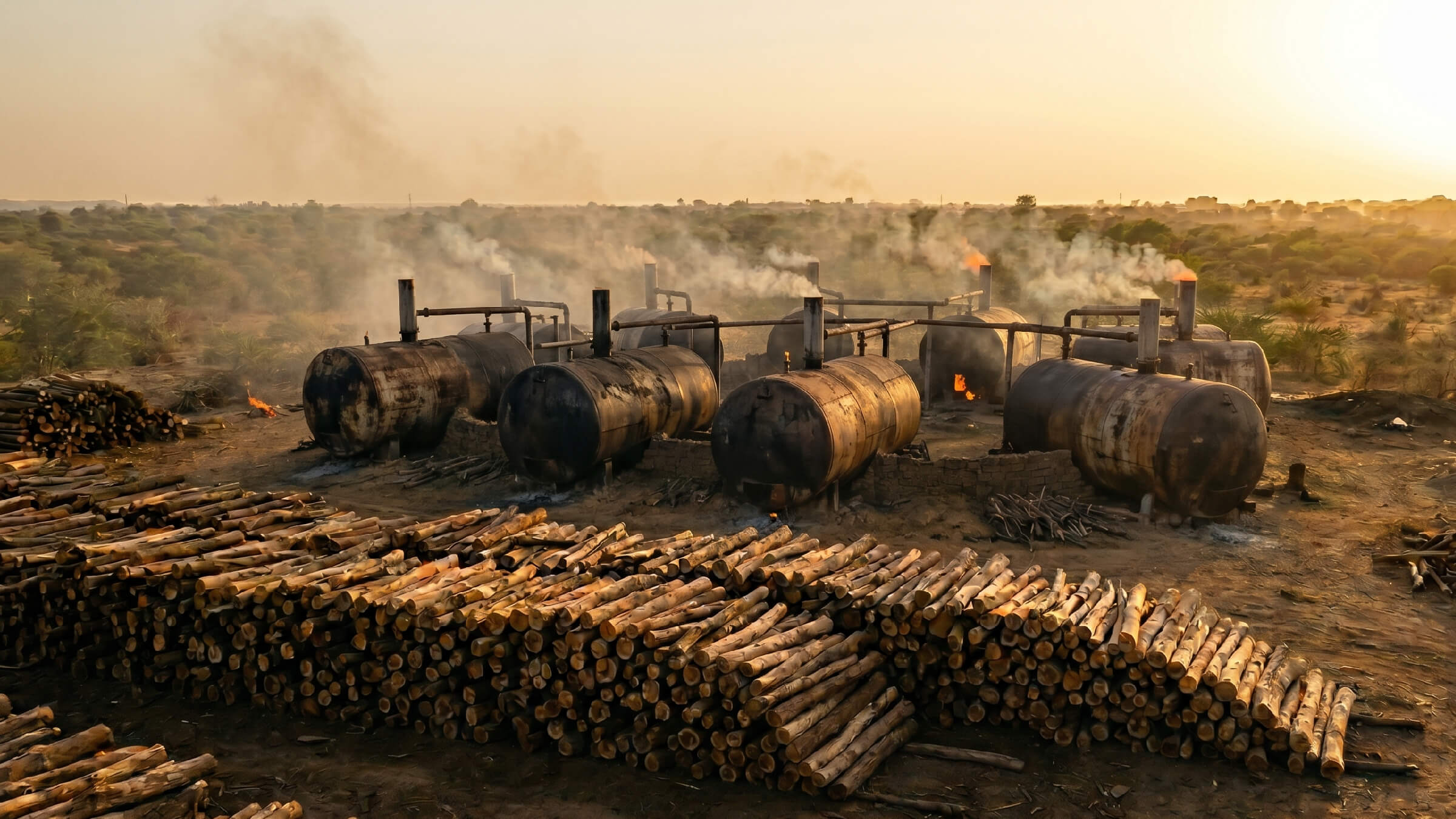
From feedstock to embers.
And back to soil.
Charcoal is not magic — it is a thermal-decomposition process that has been refined for two thousand years. Here is what actually happens between the day a bamboo culm is cut and the day its ash goes back into your soil, in five honest steps.
The five-step trajectory
Feedstock → carbonisation → grading → pack → ash.
Every kilogram of charcoal we ship has the same five-step history. The kiln is where most of the magic — and most of the failure modes — happen, but the QC bench is what turns a successful kiln cycle into a shippable, COA-backed lot. Each step below corresponds to a checkpoint a buyer can ask about, and we'll have the paperwork.
- 01
Feedstock selection
Plantation hardwood prunings (mango, acacia, neem, sheesham), 3–5-year bamboo culms, and South Indian coconut shell — all sourced as waste-stream or regenerative material, never old-growth forest. Each lot is moisture-checked at intake; anything above 12% gets sun-dried before it sees a kiln.
- 02
Carbonisation kiln
Pyrolysis in a controlled-airflow earth-mound or steel retort kiln, 400–550 °C for 8–48 hours depending on raw material and target form factor. Wood gas released during pyrolysis is recovered and burned back into the kiln as process heat — net energy in vs. out drops sharply, and smoke at the chimney is largely water vapour by the back end of the cycle.
- 03
Quality grading & COA
Each batch is broken out and sampled on a 5-point spec: fixed carbon %, moisture %, ash %, volatile matter, calorific value (kcal/kg). BBQ-grade has to clear ≥80% fixed carbon; coconut hookah hexagons hit ≥85%; activated carbon goes through a separate steam-activation pass and is tested on iodine value. A per-lot Certificate of Analysis is filed with the batch and shipped on request.
- 04
Packed & shipped
Retail packs (1–10 kg) get HDPE-lined kraft bags with a printed batch code; wholesale (25 kg sacks, 5–20 MT containers) ships with the COA, MSDS, HS code and GST invoice attached. Surface-only dispatch under UN 1361 — we do not air-freight charcoal, which is the right choice for both the hazmat class and the freight economics.
- 05
End-of-life ash
Spent BBQ ash is potassium-rich, alkaline, and a legitimate garden soil amendment when applied thin and sparing — works as a slug barrier and a slow-release K source for tomatoes, brassicas and root vegetables. We tell customers honestly: don't tip a kilo on one rose bush, do mix a handful into the compost heap. The carbon goes back into the next sugarcane, mango or coconut crop.
Inside the kiln
Pyrolysis at 400–550 °C, oxygen starved, wood-gas recovered.
Carbonisation is not combustion. The kiln runs oxygen-starved — the wood, bamboo or shell heats up to 400–550 °C, volatile compounds (water, methanol, acetic acid, tars, methane) cook off, and what remains is a near-pure carbon skeleton with the cellular structure of the original biomass intact. That porous structure is why charcoal lights, burns long, and adsorbs.
Wood charcoal takes the longest — 24–48 hours for a full mango-acacia batch in a steel retort. Bamboo is faster, 12–18 hours, because the culm walls are thinner. Coconut shell hexagons and pillows are produced from already-carbonised shell granules re-pressed under heat, so the kiln cycle for the raw shell is its own 8–12-hour pass before pressing.
Two kiln choices, each with trade-offs we are honest about. The earth-mound kiln is the traditional Indian build — cheap, scales to remote sites, but smoky at the start of the cycle and wasteful of wood gas. The steel retort kiln recovers the wood gas and burns it back into the firebox as process heat — cleaner stack emissions, better yield per kilogram of biomass in, but capex-heavy. Our hardwood and bamboo lines are steel-retort; coconut shell carbonisation runs on a mix.
Yield is the honest number nobody likes to publish: roughly 25–30% for hardwood (1 kg charcoal per 3.5 kg wood in), 30–35% for bamboo, and 30–33% for coconut shell. The rest is volatile mass burned off as process heat or vented as water vapour. There is no kiln on earth that gets you a 1:1 yield, and anyone who claims otherwise is selling something other than charcoal.
The QC bench
Five numbers on every lot. Same paperwork, retail or container.
Every batch is sampled on the same five-point spec — fixed carbon, moisture, ash, volatile matter, calorific value — against an internal target band for the SKU. A 5 kg home BBQ pack and a 20-foot export container are held to the same numbers, on the same paperwork. The COA you receive is a real lab sheet, not a generic marketing PDF.
For activated carbon we layer on a steam-activation pass and add iodine value, methylene-blue value and apparent density to the spec sheet — those are the numbers a water-treatment or industrial adsorption buyer actually cares about, and they sit on the COA beside the carbon-content number.
When a lot drifts off-spec, it does not get the SKU's grade label. Below-spec wood charcoal becomes “industrial-grade” lump for metallurgy buyers who do not need food-safe binding; off-spec briquette dust gets pressed into the next pillow run. Nothing is shipped under a grade it does not meet.
Certifications & paperwork
Every badge ties back to a downloadable document.
If a certificate lapses, the badge comes off the site within seven days — process, not promise. Full set is on the certifications page.
FSSAI food-contact
BBQ lumps, briquettes and hookah hexagons cleared for direct food-contact under FSSAI norms. Natural starch binder only — no petrochemical accelerants, no boric acid, no waxes.
ISO 9001 quality management
Documented production SOP, per-lot QC sampling, traceable batch metadata from kiln to carton. Every shipment reverse-maps to a kiln cycle and a sampling sheet.
MSME-registered manufacturer
Udyam-registered manufacturing entity — not a re-labeller, not a trading house. The kiln, the packing line and the QC bench are in the same Rajkot facility.
GST 2.0 compliant
HSN 4402 / 4404 for charcoal, HSN 3802 for activated carbon, GST 5% / 18% slabs applied via HSN-rule overrides. Tax invoices include CGST+SGST or IGST as appropriate, with GSTIN input-credit on B2B orders.
SGS / FDA export documentation
For export lots, SGS testing certificates and FDA documentation are produced per container. Standard turnaround 5–7 working days from order confirmation.
Try a starter lot — or request a wholesale quote.
The fastest way to evaluate a charcoal supplier is to put a 5 kg pack on your grill or in your kiln. Shop the full catalogue at list price, or submit a wholesale enquiry for 25 kg sack pricing, container-load freight and per-lot COA.