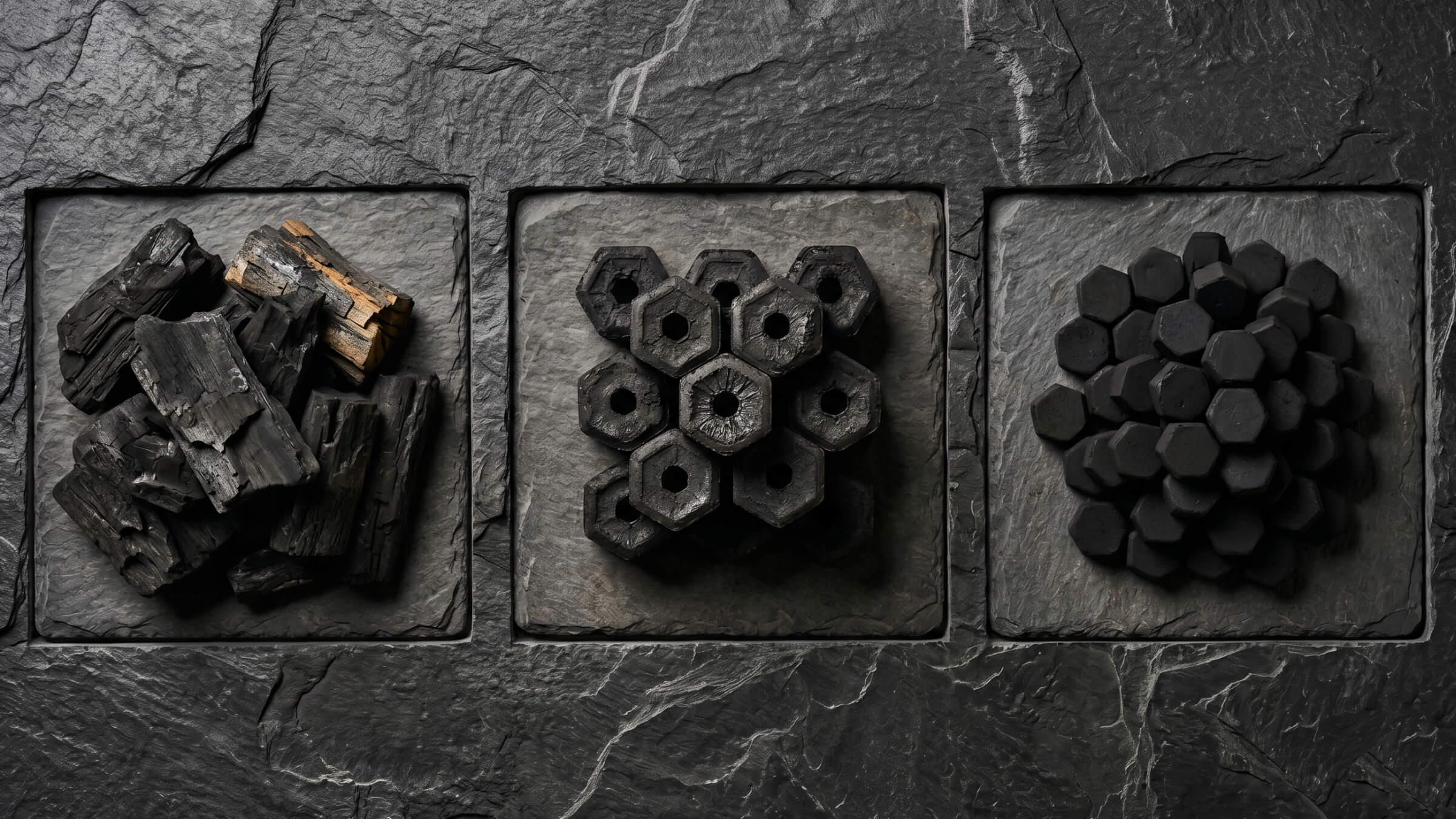
Coconut Shell vs Wood Charcoal Briquettes: Which is Cleaner?
A side-by-side on ash, smoke, burn time and cost. Coconut shell wins on clean burn, wood wins on heat — here's the breakdown and when each one is right.
When a catering operation or BBQ enthusiast upgrades from local-shop charcoal, the first question is usually coconut shell or wood. Both are sold as "premium." Both cost 2–3× the local baseline. Only one fits your use case — and the differences are bigger than the marketing lets on.
The headline comparison
| Factor | Coconut Shell | Wood (Hardwood) |
|---|---|---|
| Fixed carbon | 80–85% | 70–78% |
| Ash content | <3% |
4–8% |
| Burn time (briquettes) | 60–90 min on bowl / 2 hrs grill | 2–3 hrs grill |
| Smoke | Minimal, near-odourless | Aromatic, mildly sweet |
| Cost (per kg retail) | Higher | Lower |
| Best for | Hookah, Japan/Middle East export, yakitori | Tandoor, Western BBQ, catering bulk |
Coconut shell — the case for clean
Coconut shell's strength is what it doesn't do: it doesn't smoke, doesn't leave ash, doesn't throw flavour. That's perfect for:
- Hookah / shisha where smoke other than tobacco-steeped vapour is unacceptable. Our Coconut Shell Hexagon Briquettes are the global standard for premium lounges.
- Yakitori and Japanese cuisine where the cook wants the protein's natural flavour to dominate, not smoke. Our Coconut Cube Briquettes are specifically popular in Tokyo/Osaka lounges.
- Indoor catering (though still requires ventilation by fire code) — low smoke makes coconut workable in ways wood isn't.
Wood — the case for character
Wood charcoal's advantage is the flavour it adds. Tandoor meat cooked over mango hardwood is different — noticeably more savoury, more aromatic — than the same meat cooked over coconut shell.
For:
- Tandoor kitchens where smoke character is part of the dish
- Western BBQ (brisket, ribs, pulled pork) where wood smoke is the whole point
- Outdoor home grilling where a longer sustained burn matters more than clean ash
The right pick is Hardwood Charcoal Lumps or BBQ Pillow Briquettes depending on form preference.
Cost note
Per kg, coconut shell retail is 30–50% more expensive than hardwood. But coconut's higher fixed carbon means you need 10–15% less of it to reach the same heat output. Net difference for an hourly BBQ session: ~20% more cost for coconut.
For a hookah session, coconut shell is the only sensible option — the "clean burn premium" is worth every rupee.
The compromise: bamboo
If you want cleaner-than-wood without the full coconut price, bamboo briquettes sit in the middle: 78–82% fixed carbon, low ash, mild smoke, and a price between wood and coconut.
Bottom line
- Hookah lounges / shisha cafés → Coconut shell hexagon, no exceptions
- Japanese / Korean grill restaurants → Coconut cube
- Tandoor / Indian restaurants → Wood (specifically hardwood lumps)
- Western BBQ / slow smoke → Wood
- Home grilling, mixed-use → Depends on what you cook most
See the Compare by Material page for a full side-by- side of all three raw materials.
Ready to buy?
Browse our full product catalogue or request wholesale pricing.